

When the Journey Comes Home
Why the healthcare journey doesn’t end when treatment does and why returning home is one of the most important stages of cross-border care.
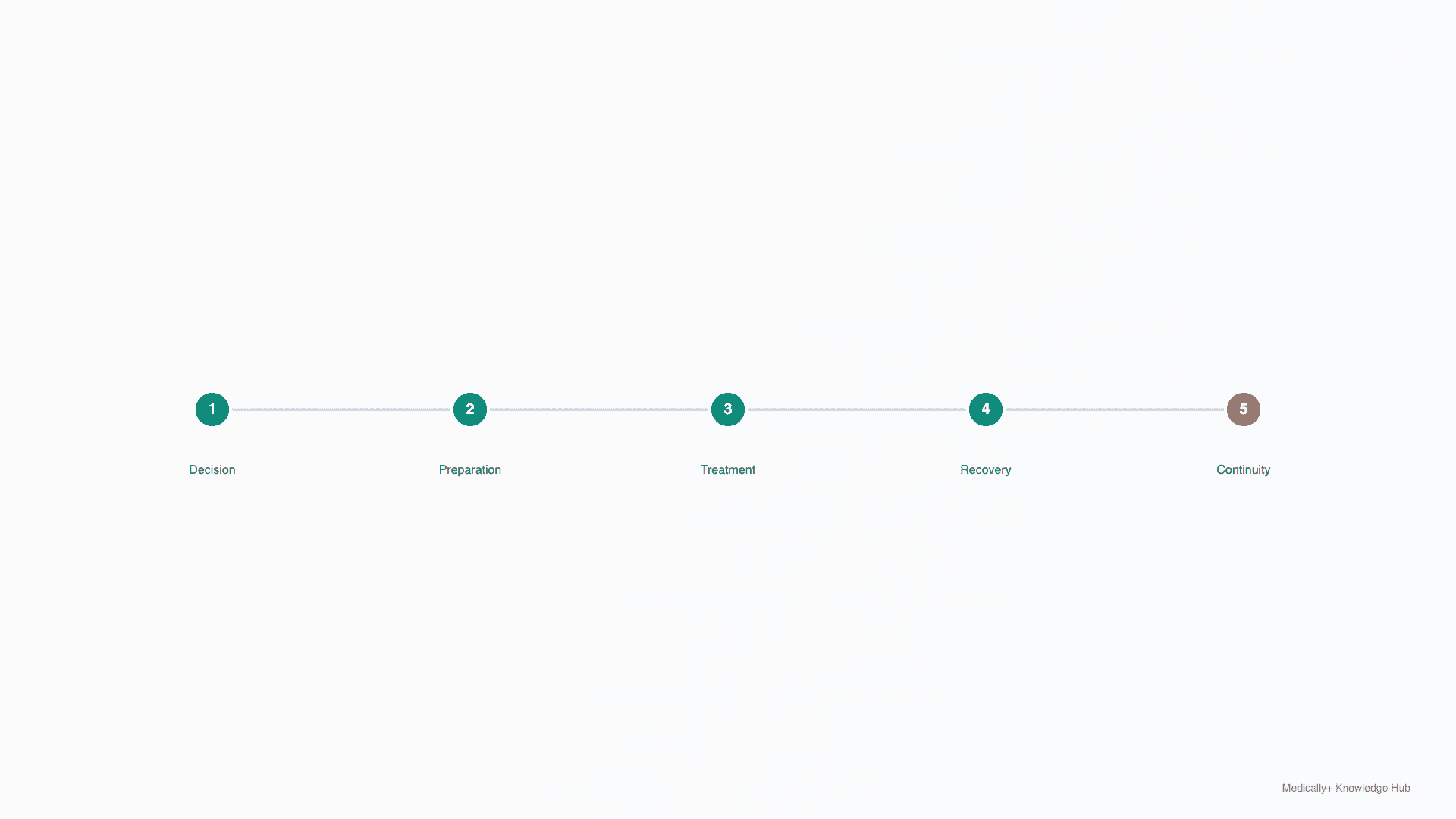
When the Journey Comes Home
Why the healthcare journey doesn’t end when treatment does.
Most people preparing for treatment abroad become, for a short time, remarkably well informed. They read about the procedure. They compare what different clinics say. They learn the name of the surgeon, the details of the technique, the length of the hospital stay. They prepare questions, arrange flights, and plan the first difficult days after the procedure.
And then, almost universally, the preparation stops at the same place: the journey home.
Ask someone who has travelled for treatment how much time they spent preparing for the procedure, and they can usually tell you in detail. Ask how much time they spent preparing for what would happen after they returned to their own country who they would call, what they would need, and how their care would continue and the answer is frequently a pause.
It is not that people are careless. It is that the return home rarely presents itself as something that needs preparing for. It looks like the end of the journey.
In practice, it is one of its most important stages.
Why this part of the journey matters
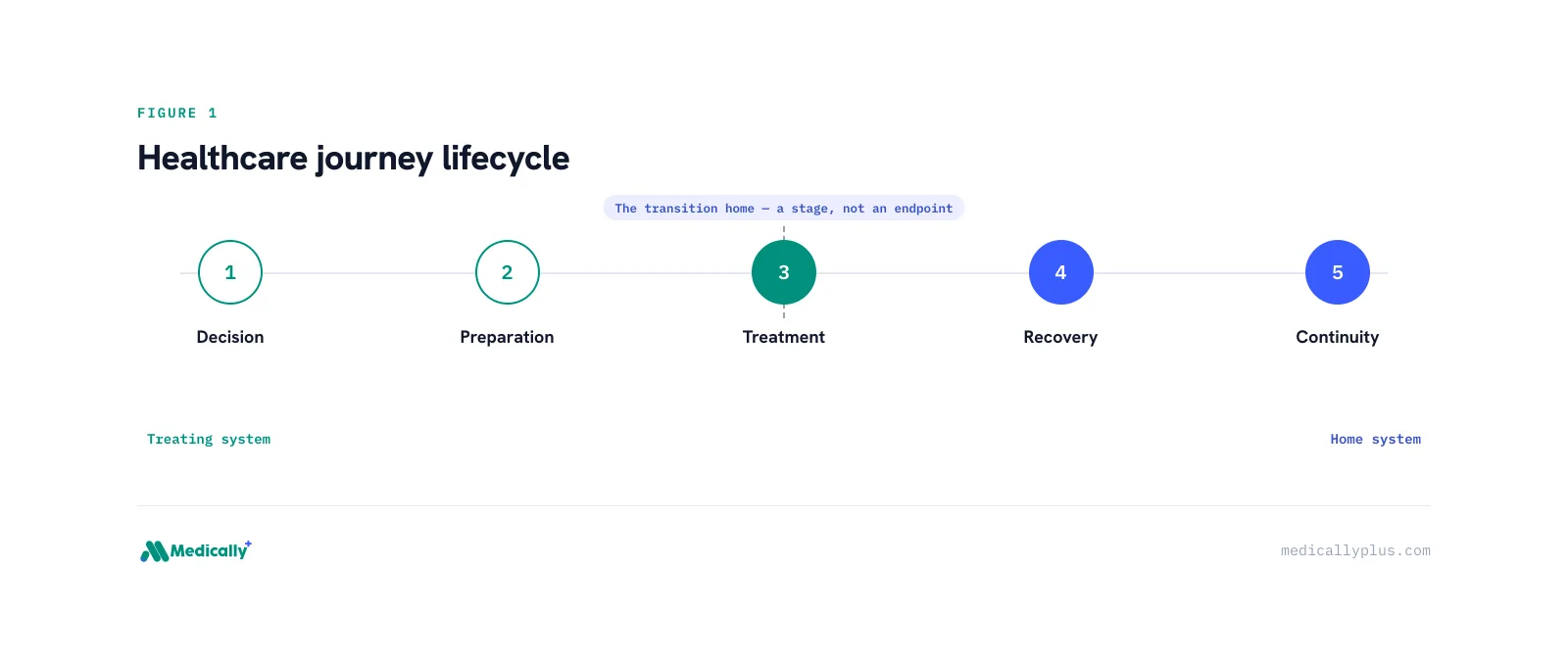
Returning home is not simply the end of travel. It is a transition between two healthcare systems that were never designed to hand a patient to one another.
When care happens close to home, continuity is mostly invisible because it is mostly automatic. The organisation that treats you can send a letter to the doctor who will follow up. They share a language, professional norms, and often systems for exchanging records.
A cross-border journey removes many of those established paths.
The organization that provided the treatment and the clinicians who will care for the person afterwards may sit in different countries, under different systems, speaking different languages, with no established relationship and no shared record.
The treatment itself can be excellent. The difficulty is that the journey now has to cross a boundary that ordinary care rarely has to cross and boundaries are precisely where things can be dropped.
This is why the return home deserves attention as a stage in its own right.
Not because anything has necessarily gone wrong, but because this is the point in the journey where responsibility, information, and continuity can become less clear.
Understanding the return-home continuity break
At Medically+, we describe this stage using a specific phrase: the return-home continuity break.
Continuity is the quality of care holding together across time and across the different people and places involved in it the sense in which today's treatment connects to tomorrow's follow-up, and the person who treated you connects to the person who cares for you afterwards.
A break in continuity is not necessarily a failure of any single clinician. It is a gap that can open between them, usually when care passes from one set of hands to another.
The return-home continuity break is the gap that can open when a person leaves the treating organisation and re-enters the healthcare system of their own country.
Why can this gap appear?
Responsibility shifts
The treating organisation's involvement often winds down once the patient is discharged and travels home.
The home system's involvement may not begin until the patient actively seeks it out.
For a period, the person can find themselves in an in-between space where it is unclear who holds responsibility for what happens next.
Information does not always travel as well as the patient
Records, discharge summaries, details of what was done, and information about what to watch for may exist but not always in a form, language, or channel that readily reaches the clinicians who now need them.
The patient can become the primary carrier of their own medical information at exactly the moment they are least equipped to be.
It is important to hold this picture without blame.
Continuity breaks are not always caused by an indifferent clinic, an unhelpful health system, or a careless patient. Often, they are the predictable result of a journey crossing a boundary that no single party was designed to bridge.
Understanding that makes it possible to prepare for.
What we currently understand
The return home has received less structured attention than the decision to travel or the treatment itself. But the broader evidence on transitions of care points to a consistent principle: moments where responsibility passes from one provider or setting to another are particularly vulnerable to gaps in information and accountability.
Cross-border care adds further complexity because the transition can involve different countries, healthcare systems, languages, professional relationships, and information systems.
Clinicians who receive returning patients can face a practical difficulty: they may have no complete record of what was done, no established relationship with the treating organisation, and no straightforward way to obtain the information they need.
Patients themselves often raise questions that reveal the same underlying uncertainty:
Who should I contact if something concerns me once I am home?
What should I bring back with me?
Will my own doctor be willing to help?
What is expected during recovery?
What happens if something does not go as expected?
These questions do not mean that every cross-border journey will experience a continuity problem.
They suggest something more modest and more useful: the return home is a stage that deserves deliberate attention rather than being treated automatically as the end.
We should also be honest about what remains unknown. There is not yet a complete, settled body of research describing cross-border continuity in every context. Much of our understanding comes from adjacent evidence on transitions of care, professional experience, patient questions, and recurring observations.
That is a reason for humility, not inaction.
A way to think about it: the first thirty days home
Understanding a problem becomes more useful when it gives us a way to organise our thinking.
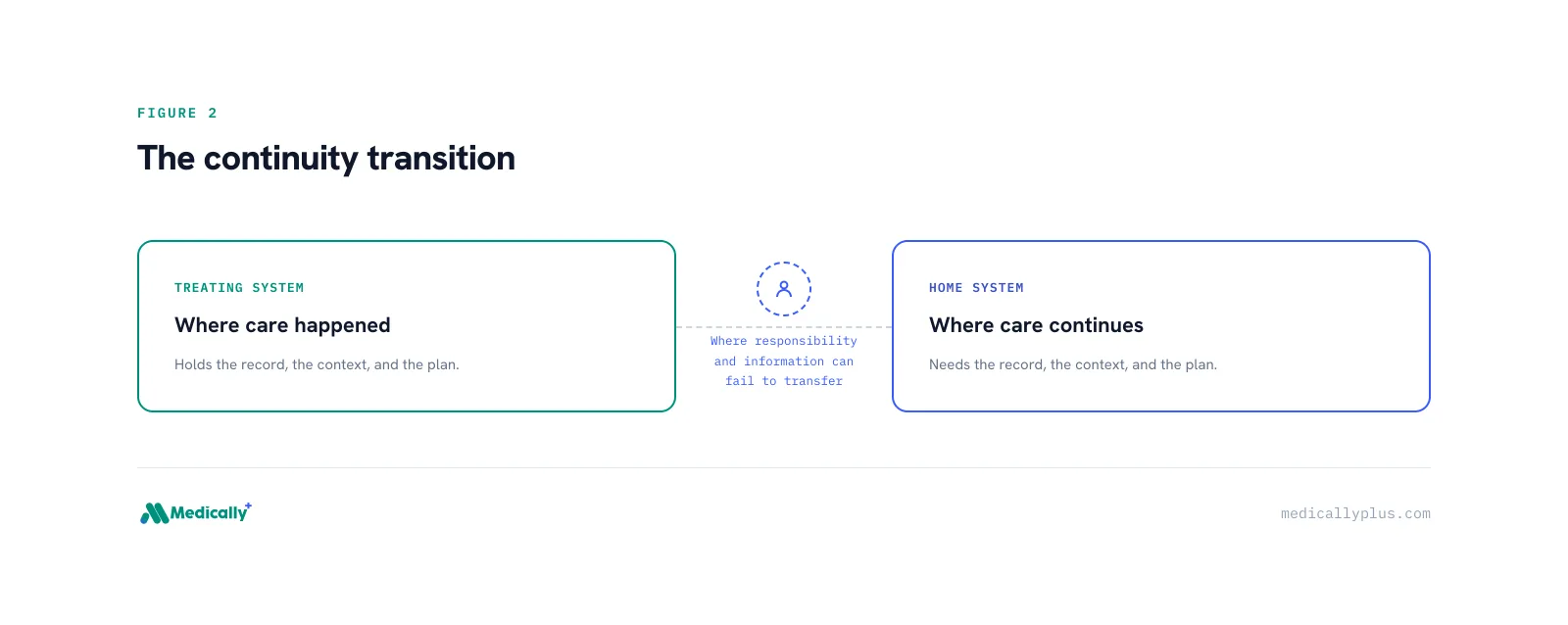
We use the phrase the first thirty days home to describe four areas worth considering during the early period after returning home.
It is not a universal clinical timeframe. It is simply a useful lens for thinking about the transition.
1. Communication
Who can be reached once the treating organisation is no longer nearby?
Before travelling home, it is worth understanding what communication channels remain available and how the treating organisation can be contacted if questions arise.
It is also worth understanding whether the relevant clinicians at home know about the treatment.
The goal is not to script every conversation.
It is to know that the channels exist before they are needed.
2. Documentation
What information needs to travel home with the patient?
What was done? What was found? What information might another clinician need to understand the treatment?
These details are much easier to gather before leaving the treating organisation than to reconstruct later from another country.
A useful question is:
If a doctor at home needed to understand this treatment next week, what would they need to have in front of them?
Documentation is a substantial subject in its own right, and deserves deeper treatment.
3. Planning
What will the return actually look like?
Recovery does not always follow the timetable originally expected. Returning home is easier to navigate when some thought has been given in advance to how continuing care might be arranged.
Planning does not mean predicting everything.
It means not leaving the foreseeable entirely to chance.
4. Follow-up
Where will ongoing care happen?
Some treatments require review, monitoring, or additional steps. It is worth understanding in advance where that follow-up is expected to happen and who is expected to provide it.
This is where the shift in responsibility becomes most concrete.
Taken together, these four areas turn the return home from an unexamined ending into a stage that can be recognized and considered deliberately.
A shared challenge, not an individual failure
It would be easy to read all of this as advice for patients to manage a personal risk.
That is too narrow.
The return-home continuity break is a shared challenge.
For clinicians who receive returning patients, the gap can create a professional difficulty they did not create. A doctor asked to support someone after treatment performed by an organisation they have never worked with may have limited information and no established communication channel with the treating team.
For healthcare organisations, continuity across borders raises questions about where one organisation's responsibility ends and another's begins.
For patients, the consequences are experienced directly: uncertainty about who to contact, what information matters, and how care will continue.
Seen this way, the continuity break stops looking like a collection of individual failures.
It becomes a systems problem arising at the seam between healthcare systems that were each designed primarily within their own boundaries.
That distinction matters.
Individual failures invite blame.
Systems problems invite understanding and eventually, better infrastructure.
Reflection
If there is one idea worth carrying away from this article, it is simple:
The healthcare journey doesn't end when treatment ends.
We often think of treatment as the destination the thing we prepare for, travel to, and complete.
But a person's health does not recognize the completion of a procedure as the end of anything.
It continues across the flight home, across the boundary between healthcare systems, and into the weeks and months that follow.
The journey continues with it.
Treatment is a stage within the journey, not its conclusion.
Recognizing the return home as part of the journey does not make healthcare more complicated.
It makes an existing complexity visible.
And once a stage is visible, it can be understood, prepared for, and eventually improved.
Continuing the conversation
Every healthcare journey is different, and the return home is experienced in as many ways as there are people who make it.
This article is one way of understanding a stage that is often overlooked not the last word on it.
We welcome thoughtful perspectives from patients who have returned home after treatment, clinicians who care for them, and people working within cross-border healthcare who have seen this stage up close.
Understanding deepens through the experiences of the people who have lived it.
Part of the Medically+ Knowledge Hub
This guide examines one stage of the healthcare journey. Related stages will explore preparedness before travelling, the documents that support continuity, cost transparency, and continuity planning building a growing body of knowledge about how healthcare journeys actually work.
This article is for general educational purposes only. It does not provide medical advice, diagnosis, or treatment recommendations. Every healthcare journey is different. Patients should discuss their individual circumstances with appropriately qualified healthcare professionals.
Follow the work as it develops
New Knowledge Hub guides are published as they are ready. If you’d like to read them as they appear, you’re welcome to subscribe.